





Library of Congress Magazine July/August 2026


Features
-
6A Jazz LegendThe Library acquires the papers of arranger and musician Gil Evans.
-
10The SourceA new experiential gallery for young people makes its debut.
-
20Long-Lost Film FoundIn a dusty box, Library archivists discover a film from the dawn of cinema.
Departments


-
july / august 2026
Vol. 15 No. 4 - Mission of the Library of Congress
- The Library’s mission is to engage, inspire and inform Congress and the American people with a universal and enduring source of knowledge and creativity.
- Library of Congress Magazine is issued bimonthly by the Office of Communications of the Library of Congress and distributed free of charge to publicly supported libraries and research institutions, donors, academic libraries, learned societies and allied organizations in the United States. Research institutions and educational organizations in other countries may arrange to receive Library of Congress Magazine on an exchange basis by applying in writing to the Library’s Director for Acquisitions and Bibliographic Access, 101 Independence Ave. S.E., Washington DC 20540-4100. LCM is also available on the web at loc.gov/lcm/. All other correspondence should be addressed to the Office of Communications, Library of Congress, 101 Independence Ave. S.E., Washington DC 20540-1610.
-
news@loc.gov
loc.gov/lcm
ISSN 2169-0855 (print)
ISSN 2169-0863 (online) - Robert Randolph Newlen
Acting Librarian of Congress - William Ryan
Executive Editor - Mark Hartsell
Editor - Ashley Jones
Designer - Shawn Miller
Photo Editor -
Contributors
Naomi Coquillon
Kaley Harman
Alli Hartley-Kong
Meg Medina
Maria Peña
Rebecca Rose
Donna Sokol
Neely Tucker
Shari Werb
Connect On

America’s First Bestseller?
The Library’s Rare Book and Special Collections Division holds at least a dozen copies of “Charlotte Temple,” including an 1802 edition in which a later reader inserted newspaper clippings describing how, by the end of the 19th century, the New York City grave of a real-life woman named Charlotte Temple became a pilgrimage site for readers who mistook her for the fictional Charlotte.
Author Susanna Rowson understood how to hook her readers: Originally published in London in 1791 as “Charlotte: A Tale of Truth,” Rowson insisted in the book’s preface that she was merely fictionalizing a true story. And, in fact, she could write firsthand of the human suffering endured by many during the American Revolution. As a child, Rowson and her Loyalist family were exiled from New England and returned to Britain, where she began working as a writer and actress.
In 1792, Rowson and her husband were recruited by a Philadelphia theater manager to join his troupe in America. Through their work onstage, the Rowsons developed a relationship with printer and theater critic Matthew Carey, who brought out the first American edition of “Charlotte Temple” in 1794.

Bark Book of Batak Magic
Which, actually, it is.
This is “Poda ni pagar si jonnga,” or “Instructions for Magical Protection,” a book used by shamans of the Batak peoples in North Sumatra more than 100 years ago, written in a rarified script that few people could read then and fewer still now.

First Light on the Valley
It was breathtaking: Ayres, a landscape artist from back East who had come to California in the Gold Rush, was awestruck by a mountainous realm of waterfalls and peaks. For the next five days, he sketched and refined with graphite, ink, chalk and charcoal on paper.
One of his first drawings, “The High Falls, Valley of the Yo Semity, California,” measuring 20 by 14 inches, depicts what is now known as Yosemite Falls.
When it (and a companion lithograph) was published a few months later, Yosemite became a sensation, enchanting the rest of the country just as Ayres himself had been. His images predated the famous photographs by Carleton Watkins and the monumental paintings by Albert Bierstadt in the 1860s that would cement the valley’s reputation as the romantic dream of the American West incarnate.

In the background, Evans’ score for “Concierto de Aranjuez,” written for Miles Davis and his classic album, “Sketches of Spain.” Music Division/photo by Shawn Miller
Making Magic with Miles
This was the beginning of “Concierto de Aranjuez,” the piece that would open “Sketches of Spain,” his famous 1960 album with Miles Davis, and brother, he meant for you to play it just like he wrote it.
“He had it exactly how everything was, musically speaking, so if somebody would just breathe, he would have that in there, too,” Davis later wrote about the album’s recording sessions. And: “He was a perfectionist.”
Evans’ handwritten score — and a multitude of other works from a brilliant, decadeslong career — was recently acquired by the Library’s Music Division. There are more than 350 of his scores included, making a significant addition to the Library’s already impressive jazz holdings.

Discovering Gems
Near the end of the 20th century, the Library faced a challenge: a burgeoning collection of unprocessed materials, the result of nearly 200 years of robust collecting.
To tackle it, the Library proposed two programs to the James Madison Council, the institution’s private-sector philanthropic support group. The first: provide senior fellows with support to study the collections (this eventually became the Library’s John W. Kluge Center). The second: an undergraduate program that would enlist junior fellows (the name stuck) to help process collections.
The junior fellows dug into the Library’s treasure trove, inventorying, cataloging, arranging, preserving and researching copyright or gift collections. Each year, they unearthed gems in the collections.
The Source: Where Curiosity Sparks Discovery


Open one, and a tornado from “The Wizard of Oz” swirls to life. Another reveals a rocket launch. A third shows Rosa Parks’ pancake recipe.
At The Source, the Library of Congress’ first-of-its-kind experiential research gallery for young people, the familiar wooden card catalog becomes an entry point into history, inviting visitors to explore the past not as something dusted off in a dog-eared textbook but as something they can actively discover.
Here, the past unfolds in multiple formats. Voices echo from across time, and collection items pull young visitors into the role of budding researchers. From the moment they enter the ground floor of the Jefferson Building, they are encouraged to ask questions, make connections and explore history through a blend of nostalgia and modern technology.

The Primary Source for The Source: Kids
In fall 2021, the Library convened a youth advisory council of about two dozen children, ages 8 to 12. At the first meeting, they reviewed preliminary designs for the new space. The designs sparked a wide spectrum of kid responses — from the blunt honesty of “I like the walls, but the floor is bringing the mood down” to “oohs” and “ahhs” and thumbs-up emojis in the message chat. It quickly became clear that the voices of these young people would dramatically shape The Source’s look, feel and content.

Shari Werb helps the public connect with the Library.
Describe your work at the Library
As director of the Center for Learning, Literacy and Engagement, I have the privilege of leading a team of talented colleagues who create programs and experiences that help people connect with the Library — whether they’re visiting in person, joining online or engaging from their own communities. Our work spans the offices of Library Events, Signature Programs, Informal Learning, Literary Initiatives, Visitor Engagement, and Professional Learning and Outreach Initiatives, all shaped by a deep and ongoing understanding of our audiences.
In my role, I focus on setting direction and creating the conditions for this work to thrive. That includes building consistent, audience-focused programming frameworks — like Live! At the Library, Afternoons With the Library and Family Days — that give people welcoming, predictable ways to engage. These platforms also make it easier for colleagues across the Library to bring their ideas to life and reach the audiences they care about.
The Source

Meet Librarians:
Ask Experts

Source Book:
Compile and Share
A Long-Lost Film, Finally Found
They were from before World War I and had been shuttled from basements to barns to garages and had just been dropped off at the Library. There were about 10 of them, and they were rusted. Some were misshapen. The nitrate film stock had crumbled to bits on some; other strips were stuck together.
The librarians peeled them apart and gently looked them over, frame by frame.
And there, on one film, was a black star painted onto a pedestal in the center of the screen. The action was of a magician and a robot battling it out in slapstick fashion. After a moment, a gasp of realization: They were looking at “Gugusse and the Automaton,” a long-lost film by iconic French filmmaker Georges Méliès at his Star Film company.


News Briefs
-
Recording Registry Inducts Works by Beyoncé, Swift
Taylor Swift’s transformative pop album “1989”; Beyoncé’s standout “Single Ladies (Put a Ring On !t)”; The Go-Go’s debut album, “Beauty and the Beat”; and the original Broadway cast album of “Chicago” were among the 25 recordings selected for preservation in the National Recording Registry of the Library of Congress.Acting Librarian of Congress Robert R. Newlen in May named the 25 recordings as audio treasures worthy of preservation for all time based on their cultural, historical or aesthetic importance in the nation’s recorded sound heritage. The public made more than 3,000 nominations of recordings to consider.
The 2026 class of inductees spans 70 years of music and recorded sound. The recordings selected this year bring the number of titles on the registry to 700, representing a small portion of the Library’s vast recorded sound collection of nearly 4 million items.
MORE: loc.gov/item/prn-26-037 -
Awards Honor Excellence In Federal Librarianship
The Federal Library and Information Network (FEDLINK) recently announced the winners of its national awards for federal librarianship for fiscal 2025. These awards celebrate the innovative ways federal libraries, librarians and library technicians serve with distinction and meet the information demands of the government, business and scholarly communities and the American public.The winners were: Susan Plotner, chief librarian of Army University at Fort Leavenworth, Kansas (federal librarian of the year); Anita Crum, a library technician at the Robert F. Sink Memorial Library at Fort Campbell, Kentucky (federal library technician of the year); the Ralph J. Bunche Library at the U.S. Department of State (large library of the year); and Marine Corps Base Hawaii Library at Kaneohe Bay in Hawaii (small library of the year).
The Institutional Repository Revitalization Project at Dudley Knox Library in Monterey, California, received the 2025 Project Award.
MORE: loc.gov/item/prn-26-030


CHARTER SPONSORS Institute of Museum and Library Services, James Madison Council
PATRONS Friends of the Library of Congress
Shop

‘Next Chapter’ Onesie
Product #21303754
Price: $19.95

‘Tell Me a Story: Fantastic Children’s Books from the Library of Congress’
Product #21110046
Price: $26.95

Library Logo Socks
Product #21305939
Price: $16



Philanthropy Fosters Opportunity
When the James Madison Council formed in 1990, paid internships and fellowships were an early focus and priority. The late Mrs. Jefferson Patterson, a member of the Madison Council, established the Junior Fellows fund and helped sustain the program in its first years. Supported by numerous gifts for individual programs, the Library’s internships and fellowships span a range in duration, subject area and program focus, each providing a different step on a ladder of opportunity.
Now in its 35th year, the Junior Fellows Program has provided a vital launching pad for hundreds of individuals while also bringing new voices and experience to programs and activities across the Library. The program was sustained by gifts from individual donors Gerry and Marguerite Lenfest, who established the Knowledge Navigators Fund, and the subsequent significant contribution by the late Nancy Glanville.


Meg Medina
I can point to many activities and exhibits that have been bridging that gap. Think of the free concert series and family days, for instance. But nothing matches the excitement I feel for the latest outreach to young people: the recent grand opening of The Source.
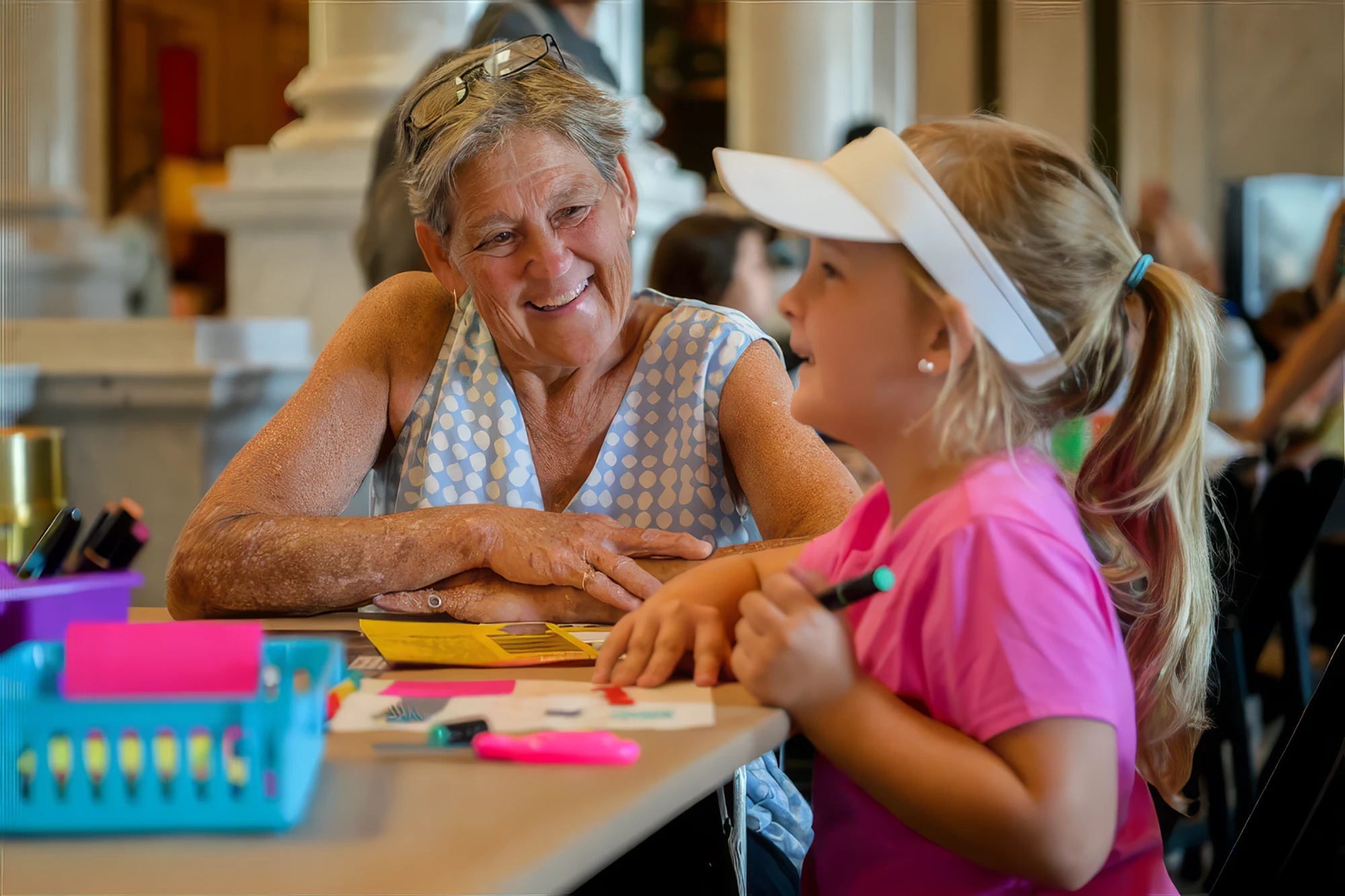
Designed for (and with the help of) young people ages 8–15, The Source: Where Curiosity Sparks Discovery now offers visitors a gorgeous new entrance space that is a hands-on introduction to the Library’s holdings. It’s a place where families can get a small taste of research as an exciting information hunt. There are sure to be favorite, high-tech features, such as the highly anticipated animated card catalog and the video chats by seven dynamic librarians talking about the different archives.
But The Source also offers the wow factor of being able to click back through time and explore images of some of the Library’s more kid-friendly and relatable holdings, such as rare comic books and memorabilia from blockbuster movies.


Current Exhibitions

Opening July 3
Here to Stay: The Legacy of George and Ira Gershwin
Ongoing
THOMAS JEFFERSON’S LIBRARY
Ongoing
More Information